
McCormick County Court Records After a Jail Arrest
After a McCormick County arrest, the first public trace may be jail intake, a warrant, or a citation. The court record is different. It starts to take shape when the matter reaches magistrate court, General Sessions Court, or the Eleventh Judicial Circuit Solicitor's Office. The official McCormick Magistrate's Office says magistrates issue warrants, set bonds, hear criminal and traffic cases, and conduct preliminary hearings. For felony and General Sessions matters, the Clerk of Court keeps criminal case records, while the solicitor determines how prosecution proceeds.
The booking side and the court side should be checked separately. Use jail inmate records to confirm whether someone is in the McCormick County Detention Center, because the county does not publish an official online current-inmate roster in the research sources. Use jail mugshots for the booking-photo question, since court indexes normally do not display mugshots. Court records after a jail arrest focus on charges filed in court, the case number, status terms, hearing events, bond conditions, and final disposition.
Find Court Records After an Arrest
The official search route is the South Carolina Judicial Branch case-records system and the McCormick County Public Index. The Judicial Branch courthouse page lists McCormick County in Judicial Circuit 11 and County Number 35, with quick links for case records, court rosters, public defender information, and the solicitor. The solicitor's public-record links page also points users to the McCormick County Public Index.
The McCormick County Public Index screenshot below is the relevant trial-court endpoint. It is useful after a case is docketed, but it is not a live jail roster and should not be treated as proof that someone is currently in custody.
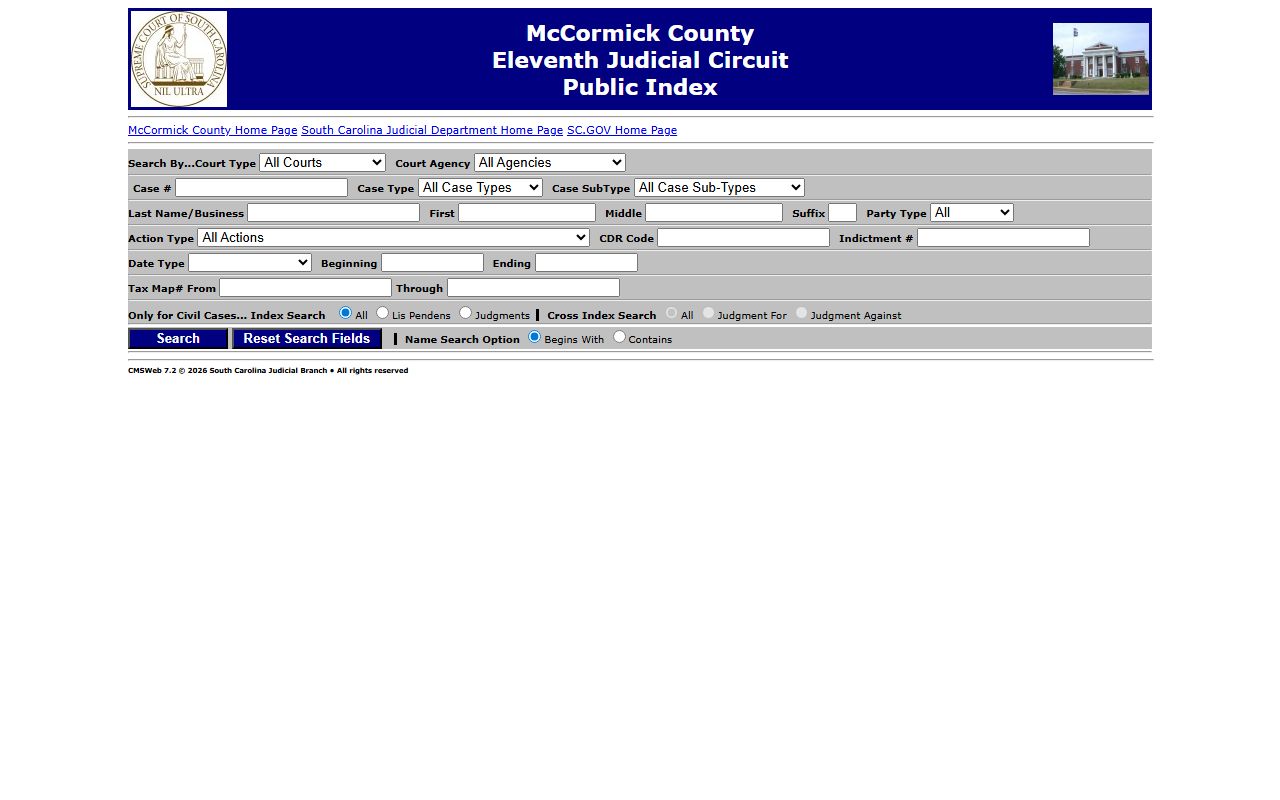
Search results can lag a recent booking because jail intake and court docketing are separate steps. If the arrest just happened, first confirm custody with the McCormick County Detention Center. Then check the court index for filed case information once the charge reaches the court system.
- Open the South Carolina Judicial Branch case-records page or the McCormick County Public Index.
- Search by defendant name when the case number is unknown.
- Search by case number if it appears on a citation, warrant, bond paper, or clerk notice.
- Open the case and review each charge, event, bond entry, disposition, and court date.
- Compare the court charge list with the original booking allegation before assuming they match.
| Field or Route | Type | Required | Notes |
|---|---|---|---|
| McCormick County Public Index | Web application | County selected before search | Official endpoint linked by SCCourts and the Eleventh Judicial Circuit Solicitor. |
| Defendant or party name | Search concept | Usually needed if no case number is known | Use the full legal name and try spelling variations when a recent arrest does not appear. |
| Case number | Search concept | No, if searching by name | May appear on warrant, citation, bond, clerk, or solicitor paperwork. |
| Court and county | Selection context | Yes | SCCourts identifies McCormick County as Circuit 11, County Number 35. |
How Charges Move From Arrest to Court Records
A jail arrest can begin with an officer's allegation, a warrant, or a bench-warrant event. Booking records show why the person was taken into custody, but the court record depends on what is filed, bound over, indicted, dismissed, or pursued by the solicitor. In McCormick County, magistrate court is important at the front end because magistrates issue warrants, set bonds, handle summary criminal and traffic cases, and conduct preliminary hearings. General Sessions criminal records are kept by the Clerk of Court.
The Magistrate's Office page documents the local bond and warrant role that often appears between booking and a later Public Index case entry.
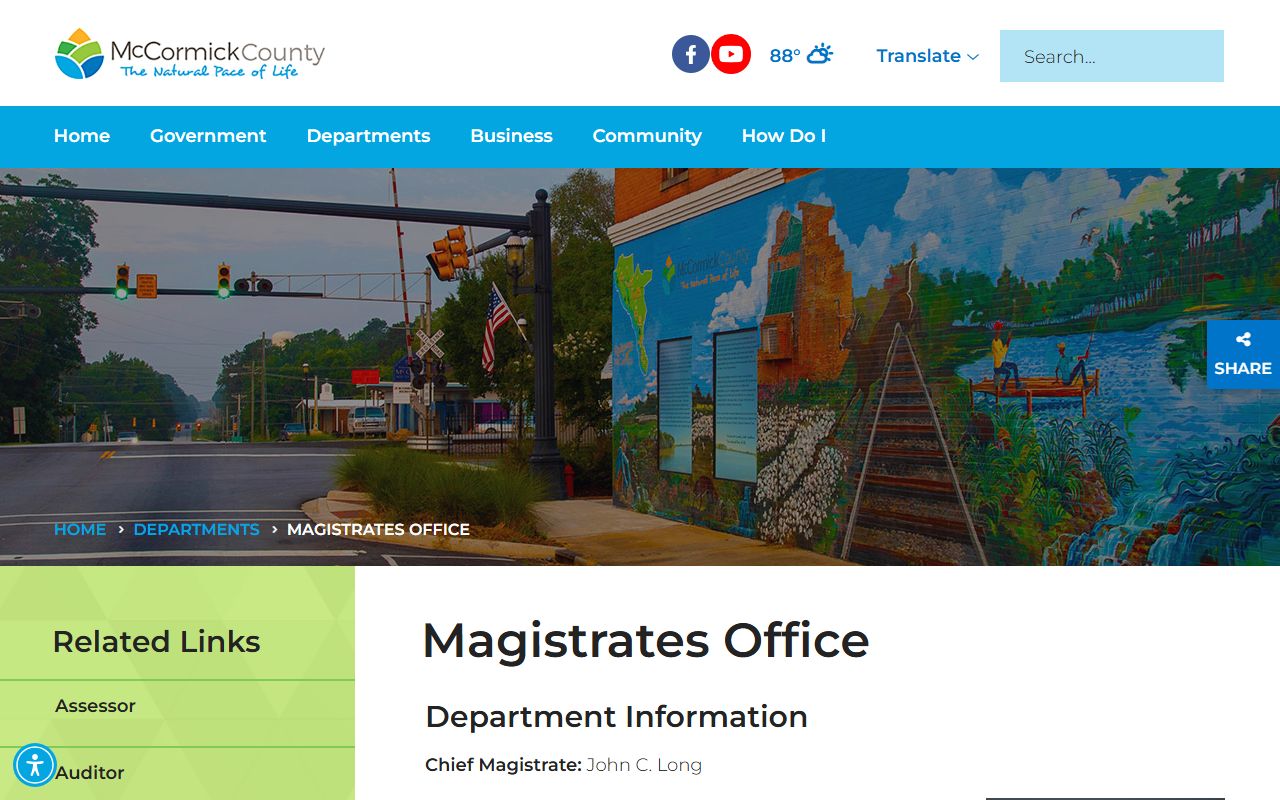
For a reader tracing court records after an arrest, that local magistrate stage helps explain why bond or warrant information may exist before a full General Sessions case is easy to locate online.
| Complaint | Information | Indictment | |
|---|---|---|---|
| Filed By | Officer or prosecutor, depending case path | Solicitor or prosecutor | Grand jury after presentation |
| Common For | Initial allegations, warrants, and summary matters | Charges pursued without using the original booking wording | Serious General Sessions felony prosecution |
| What It Starts | A court matter or charging basis | The formal prosecution track | A General Sessions charge returned by grand jury |
| Why It Matters | May differ from the final prosecuted charge | Can clarify what the solicitor chose to pursue | Often becomes the charge list people see in a felony case record |
Charge Status in Court Records
Charge status can change as a case moves from arrest to first appearance, preliminary hearing, solicitor review, indictment, plea, trial, dismissal, or expungement. The Eleventh Judicial Circuit Solicitor covers McCormick, Edgefield, Lexington, and Saluda counties. Its office may prosecute, amend, reduce, dismiss, nolle prosse, or indict charges depending on evidence, procedure, and court action. That is why a jail booking charge should be treated as an early allegation, not the final court outcome.
| Status | What It Means | How to Read It |
|---|---|---|
| Pending | The charge or case has not reached final disposition. | Look for upcoming court dates, bond entries, and docket events. |
| Bound over | A summary or preliminary matter is moving toward General Sessions. | The case may later appear under a different General Sessions case number. |
| Indicted | A grand jury returned an indictment for prosecution. | The indictment may control the charge wording more than the original booking entry. |
| Amended or reduced | The charge has changed from an earlier allegation. | Compare old and new entries before describing the case. |
| Dismissed | The charge ended without conviction. | Eligibility for cleanup depends on the court, charge type, and statute. |
| Nolle prosequi or nolle prossed | The solicitor declined to proceed on that charge. | This is not the same thing as a guilty plea or conviction. |
| Guilty plea or verdict | A conviction event occurred. | Review sentencing, probation, fines, or commitment entries separately. |
| Not guilty or acquittal | No conviction on that charge. | Check whether other counts in the same case had a different outcome. |
Bond and First Appearance After an Arrest
Bond in McCormick County should be read as a court-set release condition, not a price list published by the jail. The county detention page does not publish a bond payment portal, bond desk hours, or accepted bond methods. The practical official path is to call the McCormick County Detention Center at 864-852-0058 to confirm custody and ask whether bond has been set. For magistrate matters, the Magistrate's Office at 211 Augusta St. Ext. handles warrants, bonds, criminal and traffic cases, and preliminary hearings. For General Sessions matters, the Public Index and Clerk of Court become more important after docketing.
| Bond Type | How It Works |
|---|---|
| Cash bond | The required cash amount is posted with the proper authority and is tied to appearance and compliance. |
| Surety bond | A licensed bondsman or surety posts bond for a fee under state law and local procedure. |
| Personal recognizance | The person is released on a promise to appear, sometimes with nonfinancial conditions. |
| Percentage or property bond | Available only when authorized by the court and accepted under local procedure. |
| No-bond hold | The person cannot be released on that charge or hold until a judge or court changes status. |
| Detainer or agency hold | Another county, probation, parole, SCDC, ICE, federal, or court hold may block release even after local bond is posted. |
Warrants That Produce Court Records After Arrest
The McCormick County Sheriff's Office lists Warrant Service under Support Services, but no official online active-warrant search or most-wanted roster was located in the research sources. A warrant may come from magistrate court, municipal court, circuit court, or another authorized court. Once the person is served and booked, the court trail may include warrant information, bond action, a bench-warrant event, or a new criminal case.
Use official channels rather than unofficial warrant lists. The sheriff's main office is the local support-services contact, the Magistrate's Office can address magistrate warrants and bonds, and the Public Index can show court events after a case exists. A lower-court bench warrant may require contact with the issuing court. For a person already in the McCormick County Detention Center, ask jail staff whether a warrant, detainer, or other agency hold prevents release.
Charges vs. Convictions
An arrest and charge are not the same as a conviction. Court records after a jail arrest may be public, but they can show accusations, procedural events, dismissed counts, amended counts, or not-guilty outcomes. Treat each count separately. A person may have one charge dismissed and another resolved by plea, or an indictment may replace the original booking description.
| Charge | Conviction | |
|---|---|---|
| Stage | Accusation or formal count | Final guilty plea, guilty verdict, or accepted adjudication |
| Proof Level | May begin from probable cause or filing decision | Requires proof beyond a reasonable doubt or a valid plea |
| Where It Appears | Booking, warrant, complaint, indictment, or Public Index charge list | Disposition, plea, verdict, sentence, or judgment entry |
| Record Meaning | Does not prove guilt by itself | Shows the case reached a conviction result unless later vacated or expunged |
Sealed vs. Expunged Arrest Records
South Carolina expungement is limited by statute and procedure. The Eleventh Judicial Circuit Solicitor's expungement page says an expungement is a court order for destruction or sealing of criminal records related to an arrest or conviction. Applications must be made in the county where the arrest occurred. The solicitor processes General Sessions, Juvenile Court, and certain eligible Magistrate or Municipal Court expungements, while summary courts process dismissed, nolle prossed, or not guilty matters in their own jurisdictions.
The Solicitor's expungement page is the official local starting point for eligible McCormick County matters that fall under the Eleventh Judicial Circuit process.
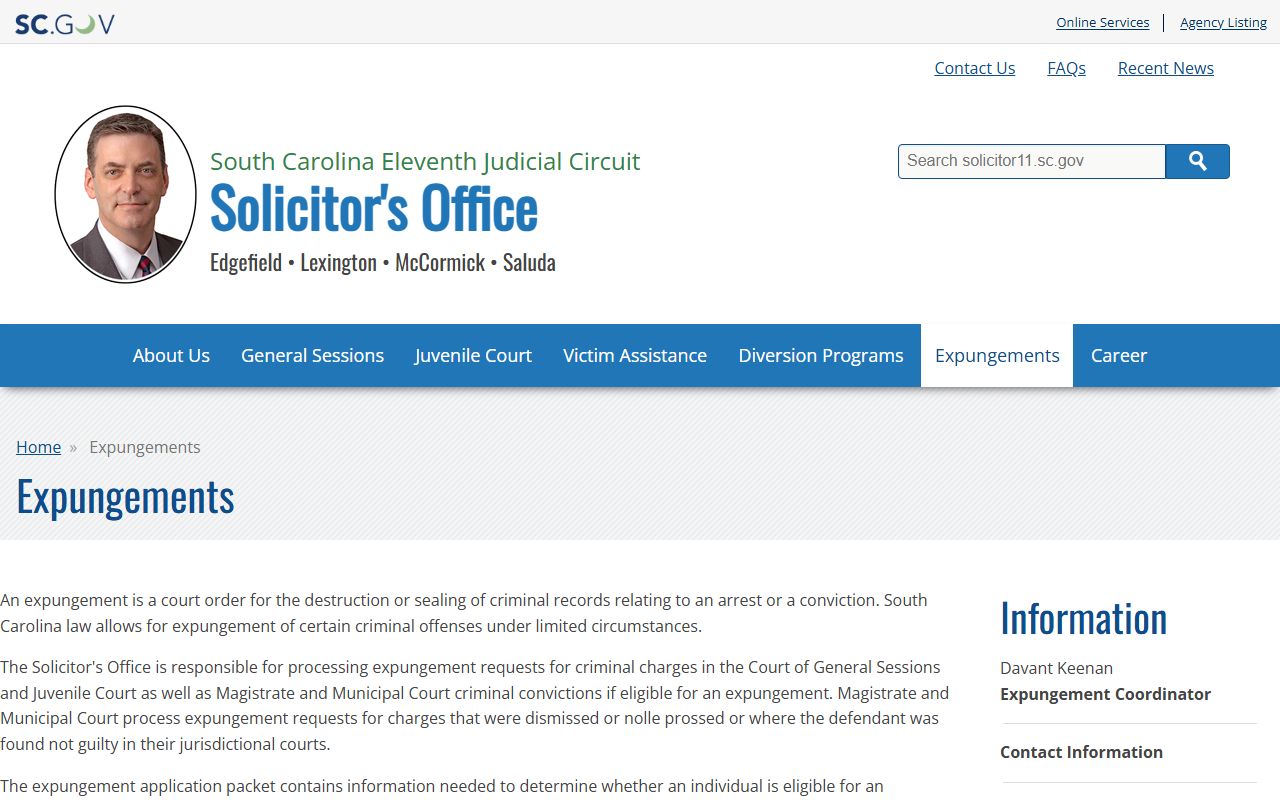
Do not assume a dismissal automatically removes a booking record, mugshot, or court entry from every public system. The cleanup path depends on the court, charge, outcome, and whether an expungement order is granted.
| Sealed | Expunged | |
|---|---|---|
| Public Visibility | Hidden from ordinary public access when a valid order applies. | Destroyed or treated as removed from public record where the statute and order apply. |
| Agency Access | May remain available for limited court or law-enforcement purposes. | May still have narrow exceptions depending statute and agency system. |
| McCormick Path | Review the court order and custodian because not every restricted record follows the same process. | Apply in the county of arrest when the matter is eligible under South Carolina law. |
| Common Trigger | Juvenile, protected, or restricted court information. | Dismissed, nolle prossed, not guilty, diversion, or certain eligible conviction categories. |
Public Access and Record Limits
South Carolina FOIA defines public records broadly, including photographs and other materials prepared, owned, used, possessed, or retained by public bodies, unless an exclusion applies. Section 30-4-30 also supports access to documents identifying people confined in a jail, detention center, or prison for the preceding three months. That does not make every law-enforcement file public. Section 30-4-40 allows withholding or redaction when release would interfere with an investigation or proceeding, invade privacy, reveal confidential sources or techniques, endanger safety, or disclose other exempt material.
Court charges are separate from booking records. For court records after arrest, use SCCourts, the McCormick Public Index, the Clerk of Court, and the solicitor's office. For booking records not found online, use the detention center, sheriff records channel, and county FOIA process. For statewide criminal history, SLED criminal-history dissemination is governed by Title 23, Chapter 3 and is not the same thing as a free Public Index lookup.
Background Check Considerations
A casual Public Index search is not the same as a legally compliant background check. Employers, landlords, lenders, insurers, and screening companies have separate duties under federal and state law. A court record may also be incomplete if a charge was amended, expunged, sealed, or recently filed.
Important: McCormick County Inmate Population is not a consumer reporting agency and must not be used for FCRA-covered decisions.
Restricted Court Records After an Arrest in McCormick County
Some arrest-related court records may be restricted, redacted, delayed, or unavailable online. Common limits include juvenile matters, sealed charges, expunged records, victim information, protected witness material, medical or mental-health details, confidential-source information, and active-investigation material. A record can also be absent from the Public Index simply because it has not been docketed yet or belongs in a different court system.
McCormick County has two facilities that readers often confuse. McCormick County Detention Center is the local sheriff-operated jail for recent arrests, pretrial custody, bond, and local holds. McCormick Correctional Institution is an SCDC state prison for sentenced prisoners and is searched through the statewide SCDC locator, not the county jail or Public Index custody tools.